 By Nick Quirk
August 14, 2026
9 min read
By Nick Quirk
August 14, 2026
9 min read
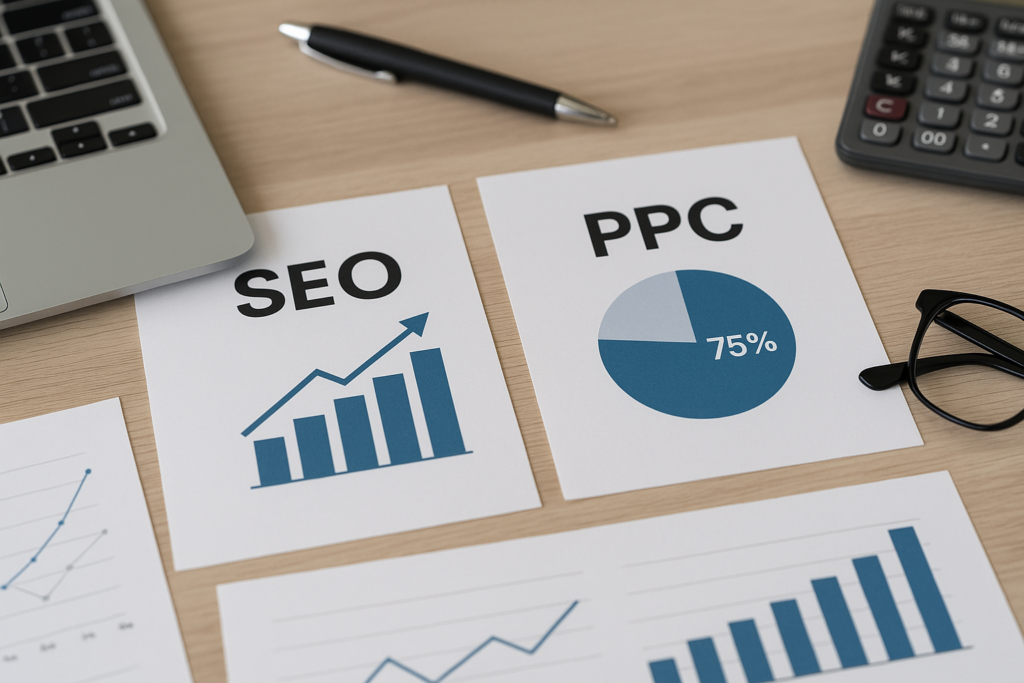
The honest answer to the SEO versus PPC question is that SEO usually wins on long-term ROI while PPC wins on speed, and the gap between them depends almost entirely on your margins, your sales cycle and how long you can wait for payback. Paid search buys traffic the moment your card clears; organic search builds an asset that keeps producing after you stop spending. Below is the actual math, not the usual generalities, so you can work out which channel makes sense for your business right now.
Quick Answer: Which One Delivers Better ROI?
Across most small and mid-sized businesses, SEO produces a higher lifetime ROI (commonly 3x to 8x over a two to three year window) because the cost per acquisition falls as rankings mature. PPC typically lands between 1.5x and 4x return, but it delivers that return in weeks instead of quarters.
- Choose PPC first if you need revenue inside 30 to 60 days, are validating a new offer, or sell something seasonal or event-driven.
- Choose SEO first if you have 6 to 12 months of runway, healthy margins, and a market where search volume is steady year after year.
- Run both if your budget clears roughly $3,000 a month, because the data each channel produces makes the other cheaper.
What SEO and PPC Actually Are
SEO is the practice of earning unpaid placement in search results through technical health, content quality and links. PPC (pay-per-click) is an auction: you bid on keywords in Google Ads or Microsoft Advertising and pay each time someone clicks your listing. PPC meaning in a company context is simply the media-buying arm of search, whereas SEO sits closer to product, content and engineering.
Both target the same searcher intent, and the difference between SEO and PPC keywords is smaller than people assume. The divergence is economic: a paid click costs the same on day 400 as it did on day 1, while an organic ranking gets cheaper to hold every month you keep it.
The Real Cost Comparison
Published Google Ads cost benchmarks vary wildly by vertical. Retail and travel keywords often clear at $0.80 to $2.50 per click, while legal, insurance, B2B software and home services regularly run $15 to $120 per click. Google’s own documentation on Quality Score explains why two advertisers bidding identically can pay very different amounts, which is where most wasted ad spend hides.
SEO costs are labour, not media. A credible retainer in 2026 sits somewhere between $1,500 and $7,500 a month depending on competitiveness, with one-off technical and content projects landing in the $3,000 to $25,000 range. That spend front-loads: months 1 through 4 usually produce very little revenue, then compounding starts.
A Worked Example
- PPC scenario: $4,000 a month at $8 per click buys 500 clicks. At a 4% conversion rate that is 20 leads, or $200 per lead. Close 25% at $2,000 average value and you have $10,000 revenue on $4,000 spend (2.5x).
- SEO scenario: $3,000 a month for 12 months is $36,000. If organic traffic reaches 3,000 monthly sessions by month 10 at a 2.5% conversion rate, that is 75 leads a month, or $40 per lead. Same close rate and value: $37,500 revenue in month 12 alone.
- Year two: PPC costs the same $48,000 to repeat those numbers. Maintaining organic rankings often costs 40% to 60% of the build phase, so the SEO cost per lead keeps falling.
That crossover point, usually month 9 to month 14, is the single most useful number in this debate. If your business cannot survive to reach it, PPC is not the inferior choice, it is the correct one.
Conversion Rates and Click Behaviour
Paid results convert slightly better on high-intent commercial terms because the landing page can be built for one keyword and one action. Organic results earn more clicks overall on informational and comparison queries, where searchers actively skip the ads.
- PPC conversion rates across search campaigns typically fall between 3% and 7%, higher in home services and lead generation.
- Organic conversion rates usually run 1.5% to 4%, dragged down by top-of-funnel content that was never meant to convert on the first visit.
- Assisted conversions matter more than either number: a large share of buyers read a blog post, leave, then return through a branded search or a retargeting ad.
Attribute everything to last click and you will systematically overvalue paid search and underfund the content that created demand in the first place. Our breakdown of long-form versus short-form content gets into which formats actually pull that early-stage traffic.
The Gap Nobody Talks About: SEO Is an Asset, PPC Is a Lease
Most comparisons stop at cost per click. The more useful frame is balance-sheet thinking. Money spent on PPC is a pure expense; the day the budget stops, the traffic stops within hours. Money spent on SEO buys pages, links and topical authority that continue producing after the invoice is paid.
This shows up when businesses are sold. Buyers routinely discount valuations for companies whose entire pipeline depends on a paid account they cannot control, because acquisition cost is a permanent line item rather than a sunk investment. A site ranking for 400 commercial keywords is treated as inventory.
There is a caveat worth stating plainly: rented traffic is predictable and owned traffic is not. Algorithm updates, AI Overviews and new competitors can compress organic clicks with no warning, which is exactly why the smartest operators keep a paid account warm even when organic is performing.
How AI Search Changed the Calculation in 2026
AI Overviews and answer engines have taken a real bite out of clicks on simple informational queries. Definitional searches (“what is PPC”, “PPC vs SEO salary”) now often resolve on the results page without a visit, which lowers the value of thin top-funnel content.
What has not changed is that commercial and local queries still send clicks, and being the source an AI system cites builds trust that a display ad cannot. Google’s SEO Starter Guide still points to the same fundamentals: crawlable pages, useful content, clear structure.
The practical shift is that SEO strategy in 2026 rewards depth, first-hand experience and original data over volume. It also means PPC has quietly become more valuable at the very bottom of the funnel, where AI summaries push paid units higher on the page.
Which Channel Fits Your Business?
PPC Tends to Win When
- You are launching a product and need market feedback in two weeks, not two quarters.
- Your average order value is high enough to absorb a $60 to $150 cost per acquisition.
- Demand is spiky (tax season, holidays, emergency services) and cannot wait for rankings.
- Your site is new, with little authority and no link profile to build on.
SEO Tends to Win When
- You sell something people research for weeks before buying.
- Your industry has punishing click costs, where paid leads exceed $250 each.
- You serve a defined geography and can dominate a local map pack your competitors ignore.
- You publish anyway, which means content spend is happening with or without a search strategy.
Local service businesses often see the fastest organic payback of anyone, sometimes in 90 to 150 days, because the competitive set is small. That is a large part of why working with a local agency tends to produce faster movement than a national retainer on the same budget.
Running SEO and PPC Together
Treating this as an either/or is where budgets get wasted. The two channels feed each other in ways that reduce blended cost per acquisition by 15% to 30% when managed as one program.
- Mine paid search query reports for organic targets. Keywords that convert on Google Ads are proven, so build content against them instead of guessing from a volume tool.
- Use PPC to test titles and offers. Ad copy that lifts click-through rate usually lifts organic click-through on the same term.
- Retire paid spend on terms you rank first for organically, then redeploy that budget to keywords you cannot reach yet.
- Defend branded terms selectively. If competitors bid on your name, a small branded campaign is cheap insurance rather than cannibalisation.
- Own both sides of the page on your highest-value commercial terms, since appearing twice measurably increases total clicks.
Whatever mix you land on, the measurement has to be honest. Set up conversion tracking properly, agree on an attribution model before you start, and track the metrics that connect to revenue rather than the ones that look good in a slide deck. Our guide to tracking search ROI covers the reporting side in detail.
A Simple Budget Split to Start With
- Under $2,000 a month: pick one. Usually PPC if you need cash flow, SEO if you have savings and patience.
- $2,000 to $6,000 a month: roughly 60% SEO, 40% PPC, shifting toward organic as rankings land.
- $6,000 and up: run both fully, and add link acquisition. If you are weighing outreach tactics, our comparison of niche edits versus guest posts is a useful next read.
Frequently Asked Questions
Which is better for my business, SEO or PPC?
If you need leads within 30 days, PPC is better; if you can wait 6 to 12 months for a lower cost per lead, SEO delivers better ROI. Businesses with margins above 40% and steady year-round demand almost always get more from organic search over a two-year horizon, while seasonal or newly launched offers justify paid.
Is SEO dead now with AI?
No. Google still processes billions of searches a day and organic listings remain the most-clicked element on commercial and local queries. What has died is thin, templated content written purely for volume, since AI Overviews now answer those questions directly, so the work has shifted toward original expertise and pages that answer buying-stage questions.
What is the 80/20 rule in SEO?
The 80/20 rule holds that roughly 20% of your pages generate about 80% of your organic traffic and revenue. In practice it means auditing which URLs actually earn conversions, improving and expanding those, and pruning or consolidating the rest rather than publishing endlessly.
Is PPC in demand?
Yes. Paid search remains a multi-hundred-billion-dollar global market, and PPC specialist salaries in the US typically range from about $55,000 for junior roles to $120,000 or more for senior paid media managers. Demand has held up partly because AI-driven bidding shifted the job toward strategy, creative testing and measurement rather than manual bid adjustments.
Want a Straight Answer for Your Numbers?
Every business has a different crossover point, and it is worth calculating yours before committing a year of budget. Tell us your margins, sales cycle and current traffic through the contact form, or look through what SEO Quirk works on to see whether the fit makes sense.