 By Nick Quirk
September 22, 2026
8 min read
By Nick Quirk
September 22, 2026
8 min read
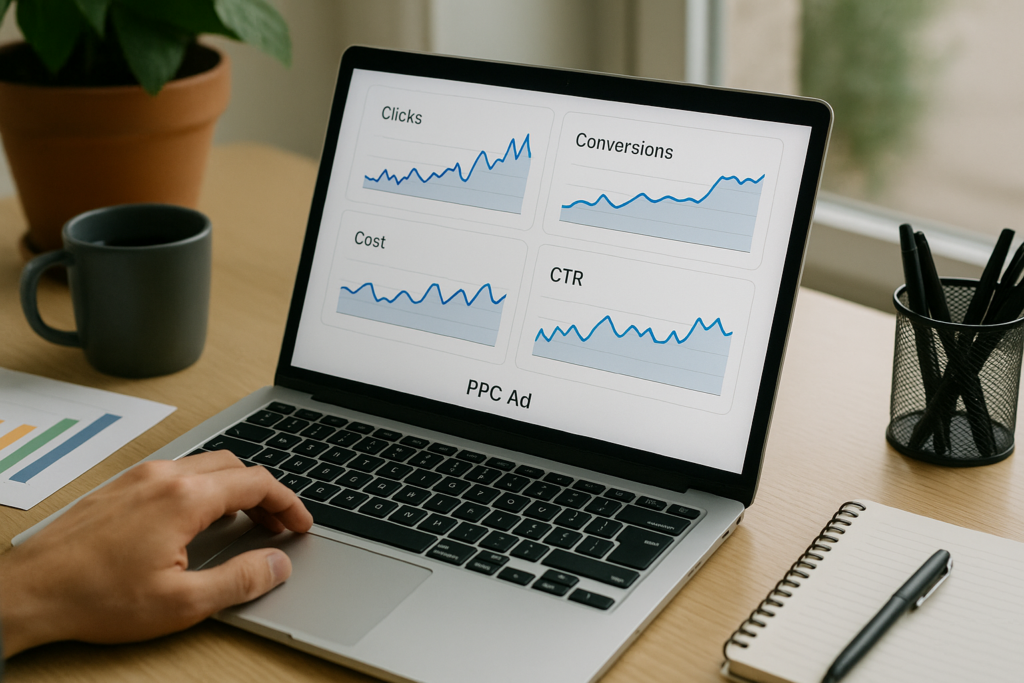
Most wasted ad spend does not happen in one dramatic blowout. It leaks out over eleven days while nobody looks at the account, which is exactly why the key PPC metrics you should be tracking every single day are different from the ones you put in a monthly client report. Daily numbers are early-warning signals; monthly numbers are autopsies.
A morning check should take about ten minutes and cover six or seven figures. Anything more than that and you will stop doing it by the second week.
Daily checks catch problems that monthly reports bury
Averaging hides damage. If a campaign spends $200 a day and one Tuesday it burns $340 with zero conversions, a 30-day average smooths that into a rounding error you will never investigate.
Daily monitoring also matters because the auction changes underneath you constantly. Competitors raise bids, a Smart Bidding algorithm shifts into a learning phase after an edit, a landing page starts throwing a 500 error, or a product feed disapproves overnight. None of those announce themselves.
The goal of a daily check is not optimization. It is detection: spotting the day something broke so you fix it on day one instead of day twenty-two.
The daily metrics that actually deserve your attention
1. Spend pacing against your target
Open with money. Compare yesterday’s spend to your daily target, and month-to-date spend to where you should be on this calendar day.
A useful rule: flag anything more than 20% above or below pace. Underspending is as much a signal as overspending, since it usually means keywords lost the auction, ads got disapproved, or a bid strategy tightened up after a conversion drought. Both directions cost you.
2. Conversions and conversion volume by campaign
Conversion count is the single number most likely to expose a broken tracking tag. If a campaign that reliably produces four to six leads a day suddenly shows zero, assume a tracking failure before you assume a market collapse.
Check the conversion action itself, not just the aggregate. Accounts that count form fills, phone calls, and chat starts under one total can lose an entire channel without the headline number moving much.
3. Cost per conversion against your ceiling
Every account needs a number you will not pay past. Work backwards from close rate and average order value: if 20% of leads close at $2,000 profit, a $400 cost per lead is break-even and $150 to $200 is healthy.
Watch the daily figure, but act on the seven-day trend. One expensive day inside a small sample means very little, while five consecutive days at 60% above target means your bidding, your audience, or your offer has moved.
4. Click-through rate at the ad group level
Account-wide CTR is close to meaningless because branded search props it up. Look at CTR by ad group and by individual ad instead, where a drop from 8% to 3% tells you a competitor changed their headline or your ad stopped serving in the top slot.
Benchmarks vary widely by industry. WordStream’s long-running benchmark data puts average search CTR somewhere in the 3% to 6% band across most verticals, with legal and B2B on the low end and dating or hobbies far higher.
5. Impression share lost to budget and to rank
These two columns tell you which problem you have. Lost impression share to budget means demand exists and you are not funding it; lost impression share to rank means your bids, Quality Score, or ad relevance cannot win the auction.
The fixes are completely different, so track them separately:
- Lost to budget above 10% on a profitable campaign: raise the daily cap or move money from a weaker campaign.
- Lost to rank above 30%: improve ad relevance and landing page experience before you throw money at bids.
- Top impression share falling week over week: a new bidder has entered your auction.
6. Search terms from the last 24 hours
This is the one report that pays for the daily habit on its own. Broad match and Performance Max both find queries you never intended to buy, and a single bad term can eat 15% of a day’s budget.
Scan yesterday’s terms, add anything irrelevant as a negative, and keep a running list. Our walkthrough on using negative keywords to protect your ad budget covers how to structure shared lists so you are not adding the same exclusion to nine campaigns by hand.
7. Invalid clicks and unusual traffic patterns
Google filters a portion of invalid traffic automatically and credits it back, but the filtering is not perfect and the credits show up after the fact. Watch for clusters: dozens of clicks from one region at 3am, a bounce rate that jumps to 95% overnight, or CTR that spikes while conversions flatline.
If any of those show up, read our breakdown of how to protect your ad budget from click fraud and bots before you assume the campaign itself is failing.
Metrics that look important daily but are not
Checking the wrong numbers every morning creates the worst habit in paid search: reacting to noise. Some figures need a week or a month of data before they mean anything.
- Quality Score: it updates slowly and reacts to accumulated history, so daily movement is mostly recalculation, not progress.
- Return on ad spend for long sales cycles: if your average lag from click to sale is 18 days, yesterday’s ROAS is fiction.
- Average position style metrics: absolute top impression share moves with competitor daypart bidding and settles out over a week.
- Performance Max asset group performance: the system needs volume, and Performance Max campaigns often take two to six weeks to stabilize after a change.
Resist editing bids or budgets daily on automated strategies. Google’s own guidance in the Google Ads Help Center is that significant changes reset the learning period, which typically runs around seven days.
How social campaigns change the daily list
Paid social swaps a few of these numbers out. On Meta and TikTok you are watching frequency, cost per thousand impressions, hook rate (three-second views divided by impressions), and cost per result by creative, because creative fatigue, not keyword waste, is the main leak.
Frequency above roughly 3.0 inside a seven-day window on a cold audience usually means CPMs are about to climb and cost per result will follow. That is a daily-visible signal, unlike search Quality Score.
Budget splits across platforms deserve their own review, and our comparison of TikTok Ads versus Instagram Reels Ads lays out how the cost per result maths tends to differ between the two.
A ten-minute daily routine
- Minute 1 to 2: account-level spend yesterday versus target, and month-to-date pace.
- Minute 3 to 4: conversions by campaign, comparing yesterday to the prior seven-day average.
- Minute 5 to 6: cost per conversion on your top three spending campaigns.
- Minute 7 to 8: yesterday’s search terms, adding negatives as you go.
- Minute 9: disapprovals, policy notices, and any campaign showing “limited by budget”.
- Minute 10: write one line in a change log with the date and what you did.
The change log is the part people skip and later regret. When performance shifts three weeks from now, the log is the only way to tell whether you caused it.
Set two automated rules as a safety net: an email alert when any campaign exceeds 150% of its expected daily spend, and one when a campaign records zero conversions for 48 hours. Those two cover you on the mornings you do not log in at all.
Frequently Asked Questions
How often should I actually log into my Google Ads account?
Once a day for ten minutes, plus a deeper 45-to-60-minute review weekly. Daily logins are for detection (spend spikes, zero conversions, disapprovals), while the weekly session is where you make bid, budget, and creative decisions on data that has enough volume to be trustworthy.
What is a good cost per conversion in PPC?
There is no universal figure; a healthy cost per lead sits below 20% to 30% of the gross profit on an average closed deal. A home services company profiting $1,200 per job with a 25% close rate can pay $60 to $90 per lead comfortably, while an ecommerce store on $40 orders needs a cost per sale under about $12.
Why did my conversions suddenly drop to zero?
In roughly nine cases out of ten it is tracking, not demand. Check that the conversion tag still fires on the thank-you page, that a recent site update did not remove the tag or change the URL, and that consent mode or a cookie banner is not blocking the pixel before you touch bids.
Should I check metrics daily on automated bidding campaigns?
Yes, but only to observe, not to edit. Smart Bidding needs about seven days of stable settings to exit a learning phase, so daily monitoring on those campaigns should be limited to spend pacing, conversion volume, and search terms rather than bid or target adjustments.
How many metrics is too many to track?
More than seven on a daily dashboard and the habit collapses. Keep spend, conversions, cost per conversion, CTR, impression share lost to budget, search terms, and invalid click signals on the daily view, and push everything else to the weekly or monthly review.
Want someone watching your numbers every morning?
We run daily checks, change logs, and negative keyword maintenance on every account we manage, which is usually where the first 15% of savings comes from. Have a look at our paid search and PPC management work, or get in touch with SEO Quirk for a look at what your account is currently leaking.