 By Nick Quirk
September 15, 2026
9 min read
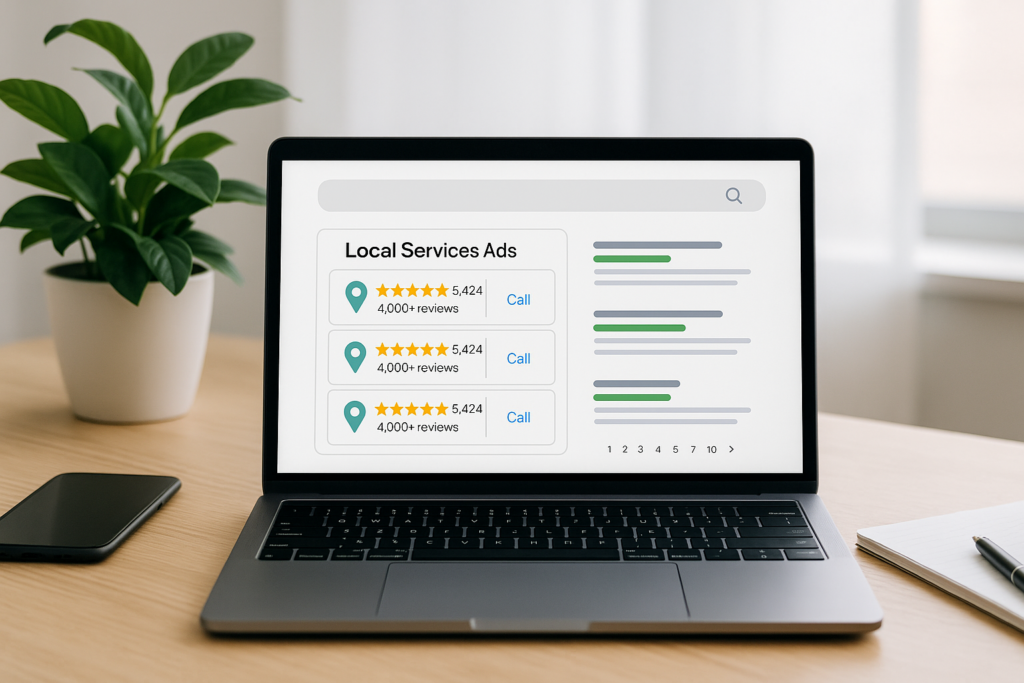
Local Services Ads are Google’s pay-per-lead ad format that sits above the regular search results and the map pack, showing a short profile, a star rating and a Google Guaranteed badge instead of a traditional headline and link. For plumbers, roofers, electricians, cleaners and most other home service trades, they are usually the cheapest route to a phone call from someone who needs the work done this week. This guide covers how the format works, what leads actually cost, how Google decides who ranks, and the mistakes that quietly drain budget.
What Local Services Ads Actually Are
Local Services Ads (often shortened to LSAs) run on a separate platform from standard Google Ads, with its own dashboard, its own verification process and a different billing model. You do not write ad copy, you do not bid on keywords, and there is no landing page to optimize. Google builds the ad from your business profile, your service categories, your service area and your reviews.
The practical difference is where the money goes. A search campaign charges you every time somebody clicks, whether they call or not. LSAs charge only when a lead comes through: a phone call over a certain length, a message, or a booking request. That shift makes the format forgiving for businesses that have never run paid search and do not have the time to babysit a keyword account.
- Placement: above text ads and above the local map results on mobile, which is where most home service searches happen.
- Trust signal: the Google Guaranteed or Google Screened badge, which many homeowners recognize even if they cannot explain it.
- Billing: per lead, not per click, with a weekly or monthly budget cap you control.
- Creative: none to write, which removes a common failure point for small operators.
Google Guaranteed vs. Google Screened
Home service trades get the Google Guaranteed badge, which requires a license check, insurance verification and a background check on the business and, in many cases, the owner. Professional services such as lawyers and financial planners get Google Screened instead, which verifies licensing and credentials but carries no money-back element.
The guarantee matters because Google backs the job, not just the ad. If a customer books through an LSA and is unhappy with the quality of the work, Google may reimburse them up to the invoice amount, subject to a lifetime coverage limit per business (currently capped at $2,000 in the United States). Details on eligibility and the claim process are published in the Local Services Ads Help Center, and they do change by country.
What Leads Cost in 2026
Cost per lead varies enormously by trade, market density and how aggressive the local competition is. As a rough planning range, most home service categories land somewhere between $25 and $150 per lead, with emergency and high-ticket work at the top end.
- House cleaning, handyman, lawn care: often $20 to $45 per lead in mid-sized metros.
- Plumbing, electrical, appliance repair: commonly $40 to $90, higher for after-hours emergency categories.
- HVAC installation, roofing, garage doors: frequently $70 to $150 in competitive markets.
- Legal and financial (Screened): $150 to $400 and up, well outside home service norms.
Those numbers only mean something next to your close rate and average job value. A roofer paying $120 per lead who closes one in four at an average of $11,000 is in a very different position from a handyman paying $35 per lead and closing one in six $250 jobs. Work the math before you set a budget, the same way you would for any paid search budget you plan to defend.
How Google Decides Who Ranks
Ranking in the LSA unit is not a straight auction. Google weighs a handful of signals, and several of them have nothing to do with money.
- Proximity: how close your business address is to the searcher, which is why sprawling service areas rarely perform evenly.
- Review score and volume: both count, and the reviews shown in LSAs include ones collected through the LSA platform itself.
- Responsiveness: answered calls, reply speed to messages, and how consistently you pick up during your stated hours.
- Business hours: profiles set to 24/7 get exposure on late-night emergency searches, but only if someone genuinely answers.
- Budget: a bigger weekly budget buys more impressions, not a better position on its own.
- Complaint history: serious or repeated complaints can suppress a profile or trigger suspension.
The responsiveness factor surprises people. Missed calls do not just waste the lead you already paid for, they push you down the ranking over time. Businesses that route LSA calls to a voicemail box almost always see impression share slide within a few weeks.
Related reading: Geo-Fencing and Pinpoint Location Targeting for Local Businesses.
We cover this topic in more depth in Twitter (X) Ads: Are They Actually Worth It for Your Business?.
Setting Up Your Profile Without Delays
Verification is the slowest part of the process, usually one to three weeks depending on how fast you supply documents and how quickly the background check clears. Have the paperwork ready before you start.
- Confirm eligibility for your trade and ZIP codes on the Local Services Ads signup page, since category availability differs by country and region.
- Gather documents: trade license numbers, a general liability certificate of insurance naming the correct legal entity, and owner details for the background check.
- Pick your categories carefully. Selecting every service you technically offer invites cheap, low-value leads you do not want.
- Set a realistic service area. Start tight around your base, then expand once cost per lead stabilizes.
- Set hours you can honor, and forward calls to a person or a live answering service rather than a voicemail.
- Import and request reviews through the LSA dashboard, which sends a direct review link to past customers.
Managing Leads and Disputing the Bad Ones
Not every charged lead is a real one. Spam calls, wrong-number calls, recruiters, salespeople and requests for services you do not offer all get billed initially, and it is on you to flag them. You can dispute a lead in the dashboard, generally within 30 days of the charge, and credits typically appear within a few business days when approved.
Set a routine: review new leads twice a week, mark them as booked or not, and dispute anything invalid the same week. Businesses that never dispute often accept 10 to 20 percent waste they could have credited back. Marking leads as booked also feeds Google data about which requests actually convert for you.
LSAs Alongside Search Ads and Local SEO
Local Services Ads are one slot on a crowded results page, and treating them as your whole strategy leaves gaps. The LSA unit appears for high-intent service queries, but plenty of valuable searches (product comparisons, brand names, “cost of” research) never trigger it at all.
A practical stack for a home service business looks like this: LSAs for emergency and “near me” demand, a tight search campaign for branded and high-value non-LSA queries, and an optimized Google Business Profile plus service-area pages carrying the organic side. If you already run search campaigns, it is worth revisiting your bidding approach once LSAs start absorbing the easiest calls, because your remaining search traffic will skew more toward research. Dynamic Search Ads can be a useful backstop for catching the long tail LSAs miss.
There is also a reason so many trades hand this off. Reviews, disputes, category tuning and budget pacing are weekly chores, not a one-time setup, which is part of the broader case for working with a local agency that understands your market rather than a distant call center.
Mistakes That Waste Budget
- Selecting every service category and then complaining about irrelevant leads.
- Listing a 60-mile service radius when your crews realistically cover 20.
- Ignoring the dispute window, which is free money left on the table.
- Letting reviews stall, since review volume directly affects how often you appear.
- Running 24/7 hours with nobody answering after 6pm.
- Treating LSAs as a replacement for organic local visibility rather than a supplement to it.
Frequently Asked Questions
How much do Local Services Ads cost per lead?
Most home service businesses pay between $25 and $150 per lead, depending on trade and market competition. Cleaning and lawn care sit at the low end, while HVAC installation and roofing in dense metros often exceed $100 per lead.
How long does Google Guaranteed verification take?
Verification usually takes one to three weeks once you submit license and insurance documents and complete the background check. Delays almost always come from insurance certificates that name a different legal entity than the one on the application.
Can I run Local Services Ads and Google Ads at the same time?
Yes, and most established home service businesses do. The two run on separate platforms with separate budgets, and a single searcher can see your LSA and your text ad on the same results page.
Do reviews from Google Business Profile count toward LSA ranking?
Yes, your existing Google Business Profile reviews are factored in, and you can also collect reviews through the LSA dashboard’s direct request link. Both review score and total volume influence how often your profile is shown.
What happens if a customer files a Google Guarantee claim?
Google may reimburse the customer up to the invoice amount, within a lifetime cap of $2,000 per business in the United States. Claims are reviewed case by case, and repeated claims can affect your ranking or your eligibility for the badge.
Are Local Services Ads worth it for a one-truck operation?
Often yes, provided you can answer the phone reliably and your average job value clears roughly three times your cost per lead. Set a modest weekly budget for the first month, track booked leads, and scale from real numbers rather than guesses.
Want Your LSA Profile Pulling Its Weight?
If your Local Services Ads are burning budget on junk leads, or you have not claimed the badge yet, SEO Quirk can audit the setup and pair it with the local search work behind it. Take a look at what we do and tell us which service areas matter most to you.